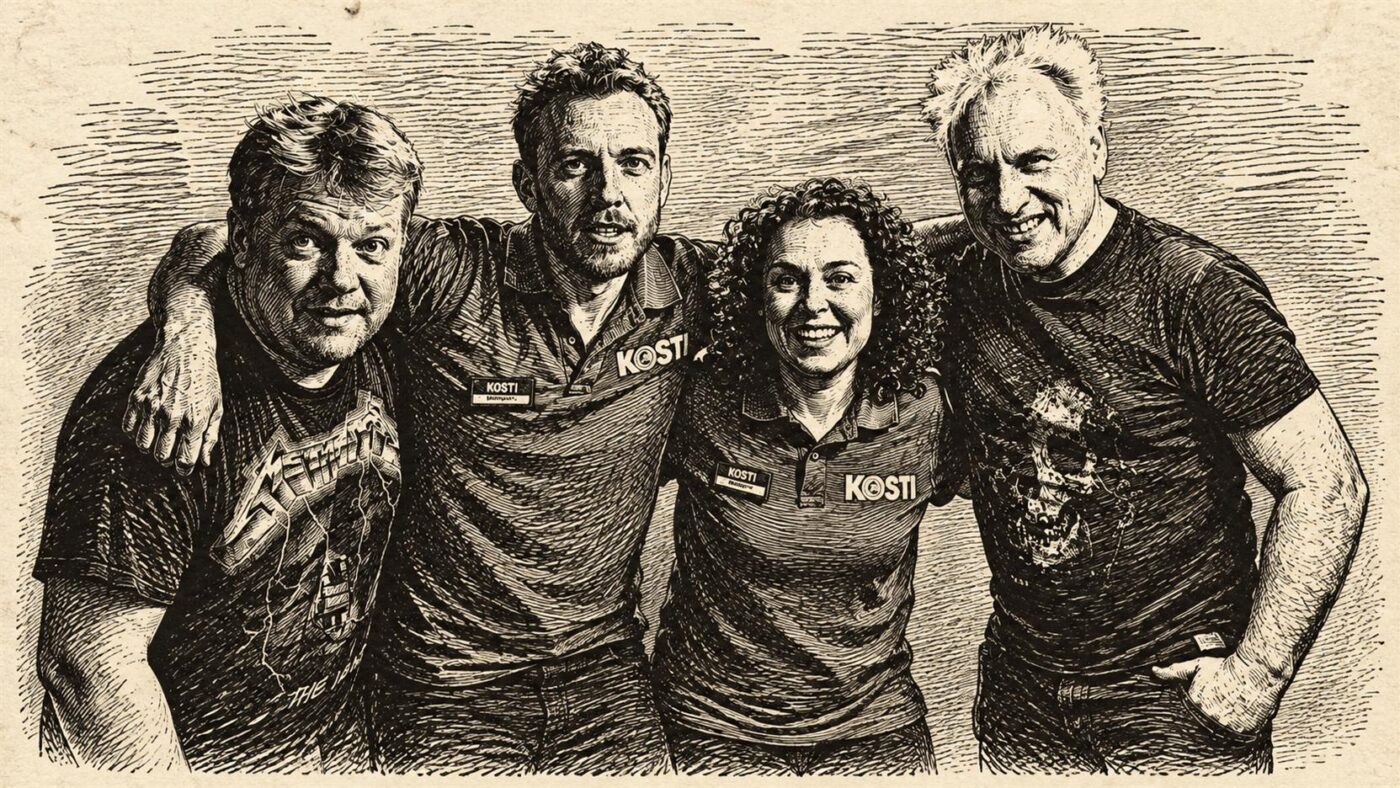
There is no altogether straightforward way to introduce Employee of the Dead. A supermarket, certainly; zombies, too; and a company of enthusiasts engaged upon an undertaking of doubtful wisdom. Yet, on reading Mr Aaron Truss’s account of his forthcoming project, I was struck chiefly by the apprehension beneath its comedy. It is, perhaps, the fear of advancing years while a long-cherished ambition, in this instance a motion picture, remains conspicuously unrealised.
Written by Mr Truss and Mr Joe Acres, who also plays the central character, Hooban, the proposed feature draws upon their director’s experiences making a student film with friends in 2008. Their resources were modest. Supermarket trolleys served as improvised camera dollies, and the entire enterprise had to be concluded before the working day began. Among those taking part was Rob Knox, whose friendship and creative enthusiasm were to give the undertaking a significance its participants could scarcely have anticipated. Knox was murdered before he could see the completed short.
To return to that occasion is therefore to encounter memories which no quantity of cheerful zombie mayhem can render uncomplicated. With the blessing of Knox’s parents, Mr Truss and Mr Acres have included in their new picture a character inspired by their friend, to be played by Mr Paul Casar. Mr Truss speaks of a wish to honour Knox’s life and imagination, and to convey something of the actor and filmmaker as he knew him.
The project has the assistance of producer Mr Jake West, remembered by horror audiences for his direction of Razor Blade Smile. Mr West recognised the possibilities of the undertaking at an early stage and encouraged its development. The cast includes Miss Dani Harmer, familiar to television audiences from The Story of Tracy Beaker, and the comedian Mr Nick Helm.
I asked Mr Truss about these beginnings, the place of sincerity in horror comedy, and what he hopes Rob might recognise were he able to take a seat at the back of the cinema and watch their youthful enterprise find new life upon the screen.
The following interview has been lightly copy-edited for punctuation and an obvious typographical error.
Lawrie Brewster: The obvious starting point for Employee of the Dead is zombies, supermarkets and comedy, which inevitably encourages people to say Shaun of the Dead. But the more one learns about the film, the less useful that comparison becomes. What do you think Employee of the Dead is really about beneath the genre surface?
Aaron Truss: Well, behind the fun of ‘zombies in a supermarket’, the idea comes from a dark and personal place, really it’s my own fear of death and not living up to my full potential as a filmmaker. I’m on the fast lane to forty now, and whilst I have a couple of feature documentaries under my belt, as well as some shorts, I really want to take the plunge into writing and directing a feature film before it’s too late. I already feel like I’ve left it too late. Most folks my age are getting married and having children, and that’s just not where my head is at right now. The older you get, the more responsibilities and commitments you have.
Employee of the Dead is exactly that – it’s the fear of living life from desk job to desk job to coffin or, in our protagonist’s case, a supermarket till. The film is about someone taking one last punt at the dream he’s had since he was a boy, filming movies on his grandad’s camcorder with his sister. He’s left it too late, and he’s convinced that if he doesn’t make his horror film, he’ll be a failure for the rest of his life. We do draw upon the metaphor of people acting as zombies in everyday life (which is not a new concept at all), but it’s more of a subjective point of view from our protagonist, Hooban. Joe Acres (my co-writer and the actor who plays Hooban) and I both realised that there were a lot of primal fears in this story, and a lot of the early drafts were written during a very similar period in my life, when everything seemed bleak. So I figured, let’s just use that in the story – and I think that’s why a lot of people relate to the script. I would say this is the most personal thing I have ever written. If you read the script, you’ll find a lot of me in there, warts ’n’ all.
Lawrie Brewster: The original film seems to occupy an extraordinary place in your memory because it captured a group of young friends doing something completely reckless and creative together, shortly before Rob was killed. When did you first realise that returning to that material could be a celebration rather than simply an unbearably painful exercise in nostalgia?
Aaron Truss: That is a great question! I never really saw it as a celebration at first. In fact, it was just a student film that I was embarrassed about, as it’s such an early example of my work from university. It’s also Rob on the screen, and that brings up a whole mixed bag of feelings. On one hand, there he is in living colour – though he’s not with us. But some of the techniques we used, in terms of dolly tracking shots, were inspired! We used supermarket trolleys! We called it the ‘Trolley-Dolly’, which was born out of sheer desperation, as all we had was a Sony PD-150, a tripod and a DI boom mic. We were constantly trying to invent new ways of framing shots and utilising our supermarket surroundings.
These are the things I started remembering when I was considering making a feature film about our experiences – how necessity forced us to be creative in ways we wouldn’t have dreamed of before. And, to top it off, there was a ticking clock! We had until 8am to get everything we needed and leg it! That’s when I started thinking about the comedy potential on screen – a group of inexperienced filmmakers attempting what we did as teenagers, but in their late 30s, only this time, the goal was to make a feature film without the supermarket managers finding out! Exhibiting the mistakes and pitfalls that first-time filmmakers make was crucial to the comedy, but also to shining a light on how most filmmakers start out on their journey.
Lawrie Brewster: There is something almost uniquely powerful about film as a way of preserving people. Rob exists not simply in photographs or memories, but moving, performing and joking around in something you created together. Has working on this feature changed the way you think about cinema as a form of memory?
Aaron Truss: I’ll be honest, not really. I’ve always seen films as a form of time travel. They’re tiny time capsules! Sure, Peter Cushing has been dead for over thirty years, but we still have A Chump at Oxford, The Curse of Frankenstein, Tales from the Crypt, Dr. Who and the Daleks and Star Wars – and there he is! Living, breathing and alive! He doesn’t decay, and he’s there for a whole new generation of audiences to discover him and I love that.
Film, to me, is not only entertainment, but preservation. In Rob’s case, his place in cinema history is assured due to his role as Marcus Belby in Harry Potter and the Half-Blood Prince. Working on Employee of the Dead allows us to put Rob in the spotlight in a way that doesn’t involve the night he died. In fact, the character of ‘Rob’ (played by Paul Casar) is, in spirit, a loving tribute to Rob. People mostly know him as a young actor, but he was a filmmaker too! He always pushed the envelope when we were younger, and he was full of ideas – that’s the Rob I know and deeply miss. Whilst it will be Paul Casar on the big screen, it will be Rob in our hearts.
Lawrie Brewster: You have decided to make Rob a character within the new film rather than merely dedicate the picture to him. That is a much more complicated creative decision. How did you and Joe Acres decide where the boundary lay between honesty, dramatic invention and protecting something very personal?
Aaron Truss: Absolutely! We were terrified at the prospect of writing Employee of the Dead with or without referencing Rob in some way. You’re damned if you do and damned if you don’t, because he was an integral part of that original short film. In the end, we decided to contact Rob’s parents for their blessing first, and fortunately, they both loved the idea of including a character based on him. Aside from the casting, writing Rob was a challenge in the sense of trying to do him justice, being respectful of his memory, but also being honest about the kind of guy he was. Rob was no angel. He was cheeky, he was a ‘class clown’, but he was extremely protective of his family and friends. He would drop everything to help you out, and that’s the truth! His dad often remarks on how Rob inherited a large amount of money and immediately went to the bank and donated the whole sum to charity. That was Rob.
We didn’t want to emulate Rob, but we did want to capture his essence and his spirit. Joe, Jake West and I feel that Paul Casar is the perfect casting choice. Paul also understands the burden of the role and has been nothing but a joy to work with on this project since we began filming the Kickstarter promos. We covered Rob’s life and death in (K)nox: The Rob Knox Story, so we felt that the boundary was fairly obvious – we stay away from his murder and focus on his life, reimagined as if he were older and still making films with his friends.
Lawrie Brewster: A lot of independent horror now comes packaged with deliberate irony, quotation and knowing references to other horror films. Your project appears to contain all the ingredients for that kind of film, yet the emotional foundation is remarkably sincere. Were you conscious of resisting the temptation to hide behind genre irony?
Aaron Truss: There is a nod in our script to Night of the Living Dead, one we couldn’t really ignore, and I feel it’s referenced in a loving way.
I liken it to School of Rock. You don’t need to appreciate Metallica or Motörhead to enjoy the film – the important takeaway is that you believe Jack Black’s character is obsessed with that music. Hooban is the same. He’s obsessed with horror films, but the audience doesn’t need to have seen any of them to appreciate the story at all! I do find that a lot of independent horror becomes overly referential, and that can be distracting. Nick Helm is a huge champion of making sure we don’t fall into that trap. We have confidence in our script (we spent two years writing it), and we wanted to get it right without having our audience thinking about other films while they’re watching ours. We’d just be shooting ourselves in the foot.
Lawrie Brewster: Jake West seems to have been important in persuading you that Employee of the Dead ought to become your first feature. What did Jake recognise in the old film that you perhaps couldn’t see yourself, and what has he brought to the project as a producer?
Aaron Truss: Jake West has been integral to this project since day one. One Christmas, we sat down and I showed him the original short film. I was embarrassed, really. This is the guy who made Doghouse and Evil Aliens. What surprised me, though, were his questions after the viewing: ‘How did you shoot in a supermarket?’ and ‘How did you get permission?’
The truth is, I was working at Sainsbury’s on the loading bay at weekends whilst at university, and we didn’t get permission. We had 48 hours to make the film, as it was part of a challenge our lecturer had set for us. Getting permission would have taken weeks just to get a ‘no’. He loved that. He said that this film could be the basis of my first feature film, and he was right! I hadn’t even considered that. Jake became our mentor while we were writing the script over two years, eventually helping us get the screenplay down to a tight ninety pages. Once we were ready, he sent it to Dan Schaffer (Doghouse, Electric Meat, White) to do a read-through. I hadn’t met Dan at this point, and he knew nothing about me or the story – Jake simply wanted to obtain some critical, unbiased feedback. Dan offered some brilliant notes (which we implemented), but also spoke about how much it made him laugh and demanded that we not play with the structure any further.
Jake has since helped us bring Vince Knight (Winnie-the-Pooh: Blood and Honey) on board as our DOP and Simon Boswell (Shallow Grave, Demons 2) as our composer – though saving his life when he almost fell down the stairs at Picturehouse Central must have landed me a few extra bonus points. Jake was also responsible for bringing Peter Pedrero on to the project as our stunt coordinator, and he even helped coordinate a lot of the action in the Kickstarter promos! It’s fair to say that, without Jake, Joe and I would never have begun work on this project. He didn’t see a shoddy student film, he saw potential. He recognised the importance of a great location to make a film and despite our limitations at the time, found it inspired.
Lawrie Brewster: You came into filmmaking very visibly as a fan first, somebody who genuinely loves horror and its culture. Horror has increasingly become professionalised, academically discussed and absorbed into the mainstream film establishment. Do you still think there is something valuable about the obsessive fan becoming the filmmaker?
Aaron Truss: Wow, what a question! Yes, I do believe so. Combining an obsessive film fan with the right filmmaking tools and knowledge can lead to some amazing results. As a university student, I loved films by Quentin Tarantino and John Carpenter, but then I discovered Sergio Leone and it all began to make sense. So, in that sense, most definitely! You could even use yourself as an example, you have a deep love for Amicus and classic British Horror Films – now look at you! You own Amicus! It paid off!
I was obsessed with film and television from a very young age, pleading with my dad to get me a FireWire for Christmas in 2003. For those who aren’t familiar, FireWire was the only way to connect digital cameras to PCs to capture footage. I’d spend hours filming short films with my younger brother and school friends and editing them all using software called Ulead VideoStudio. This, of course, followed a spell as a child actor on stage and TV, and eventually led to me studying film and production at Thames Valley University, near Ealing Studios. I think if you’re obsessed with the craft, then the chances are you’ll make a great film. If you’re doing it for money or ego, you’re not going to get very far – I’ve seen it happen with a few people.
Lawrie Brewster: The casting is interesting because you are bringing together performers with very different associations for British audiences, including Dani Harmer, Nick Helm and figures associated specifically with cult and horror culture. Are you deliberately playing with that collective television memory when assembling the cast?
Aaron Truss: It’s funny you mention that, as that wasn’t the intention at all.
For example, Dani Harmer’s involvement is actually a personal one. Both Rob Knox and Dani Harmer appeared on the BBC sitcom After You’ve Gone as boyfriend and girlfriend. Dani was a huge supporter of the Rob Knox Foundation and Film Festival, which ran for 16 years. We’ve known each other for years, and when Joe and I were writing the script, Dani instantly came to mind. We know most folks will know her from Tracy Beaker, but we also knew that the idea of Dani appearing in a film with zombies, gore and adult humour would be brilliant. Luckily, she fell in love with the script, and her husband is also a huge fan of horror films.
Nick Helm was another incredible moment for us, as the character was written (at least from my perspective) with him in mind. The character of Joe Miotti (and Rik Venger in Hooban’s film) was always something I could see him playing. I’d opened for Nick at a comedy show years ago when I tried my hand at stand-up, and I remember we got on really well – which was great, as I was a big fan! Just by chance, I bumped into him outside a pub toilet recently in London at an event we both weren’t really planning to attend. So I jumped into ‘elevator pitch’ mode, and the rest is history. If anything, this was more about finding the right actors for the roles. It sounds like such a simple thing to say, but it’s true. Nick still auditioned for the role, and all the cast have auditioned, with the exception of Joe Acres and Dani Harmer.
So I suppose the moral of the story is, be sure to hang outside pub toilets and talent will just appear. (Please don’t do this, and no I don’t make a habit of this!)
Lawrie Brewster: Finally, if Rob could somehow sit at the back of a cinema and watch the finished Employee of the Dead, what do you hope he would recognise from that night nearly twenty years ago?
Aaron Truss: How much we loved him. How much we loved filmmaking and how that night in 2008 was one of the best nights of our lives. It certainly was for me, but I’ll never know if it was for Rob. I have often thought of this, mainly because Rob was murdered before he had the chance to see the original short film. So, I hope he’s up there having a bloody good laugh at us trying to do it all again. I’m sure he’s rooting for us too.
Readers can find further information about Employee of the Dead on the film’s Kickstarter page.
Further reading
Readers interested in the independent filmmaker’s resolve may consult our account of Mr Joel Haver and cinema beyond permission and our conversation with Mr Jeff Barker on screenwriting. Our sister publication, Amicus Horror, offers a further discussion of acting, training and tradition with Megan Tremethick.
About Mr Lawrie Brewster
Mr Lawrie Brewster is a producer and director working in independent horror cinema. He leads the British Horror Studio, serves as President of Amicus Productions, and oversees the British Horror Studio community.
Readers may also consult his reflections on acting and self-education and further articles for Amicus Horror.