
The Canadian-born filmmaker and animator has built an audience numbering in the millions without surrendering his independence. In conversation with Mr Lawrie Brewster, he considers creative freedom, film festivals, distribution and the curious reluctance to regard YouTube as a proper home for cinema.
From our Film Correspondent
There are filmmakers who spend a considerable portion of their lives waiting for permission.
They wait upon the producer, the financier, the distributor and the festival programmer. Beyond these figures may stand some distant executive who, though empowered to determine the fate of a picture, may never entirely comprehend what made it interesting in the first place.
Mr Joel Haver elected to proceed differently.
He began making films, presenting them freely to the public and steadily cultivating an audience without first requiring the traditional motion picture industry to declare his work legitimate.
The arrangement appears simple. Its implications are rather more revolutionary.
The Singular Career of Mr Joel Haver
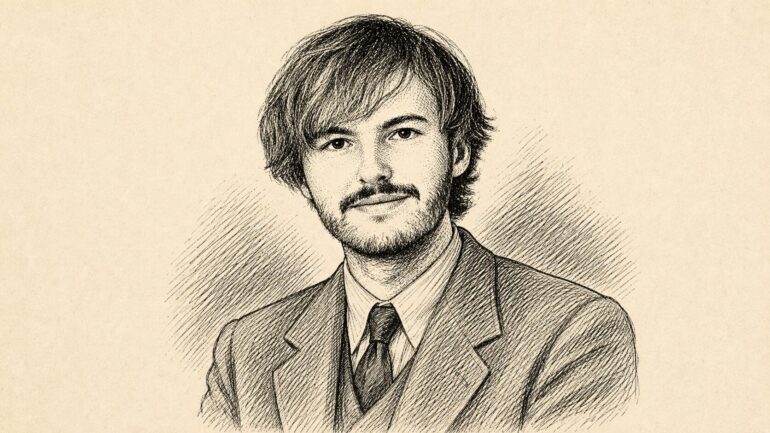
Mr Joel Haver is a Canadian-born filmmaker, animator, writer and performer who grew up in Massachusetts before studying filmmaking at the Pratt Institute in New York. Since graduating in 2018, he has assembled one of the most distinctive bodies of work to emerge from YouTube.
His channel now commands more than two million subscribers, yet its success is not founded upon the careful preservation of a single dependable formula. Mr Haver has released hundreds of short films, numerous feature-length productions and various experiments which move freely between comedy, animation, documentary and personal reflection.
Many viewers first encountered his work through a series of animated comedy shorts. These employ a loose form of rotoscoping, combining live-action performances with drawn figures who retain the peculiar hesitations, gestures and physical awkwardness of their human origins.
The results are instantly recognisable. Mr Haver’s characters inhabit worlds governed by video game logic, social embarrassment, melancholy and absurdity. They possess the appearance of crude animated figures, yet their smallest movements reveal an unexpectedly human character.
Among the most widely viewed examples are Playing an RPG for the First Time, Tailing Missions from the NPC’s Perspective, Scooby-Doo but This Happens Instead, The Giant, The Bounty Hunter and Galactic Emperor.
Several have been viewed millions of times. More significantly, the style has proved sufficiently distinctive to inspire a generation of online animators and comedians.
Such success might easily have become a prison.
Mr Haver could have continued producing animated sketches indefinitely, satisfying both an established audience and the mysterious demands of the algorithm. Instead, he continued experimenting.
Beyond the Animated Picture
Mr Haver’s wider filmography moves between improvised comedy, personal documentary, absurdism, melancholy and moments of painful emotional candour.
Recurring collaborators including Mr Trent Lenkarski, Mr Alex Martens, Mr Caleb Johnston and Mr Dax Flame have helped to establish the impression of a genuine artistic company. These are not merely performers engaged to furnish a product. They appear as friends exploring an idea together, often discovering the nature of the film in the act of making it.
His earlier feature films include Island, Pretend That You Love Me, Drowning in Potential, We Have to Leave Here Together and Things Could Always Be Worse.
These pictures are intimate, inexpensive and occasionally rough around the edges. Yet the roughness is seldom an embarrassment. It frequently becomes part of their humanity.
Mr Haver has also carried his particular sensibility into television and other established forms of entertainment. He voiced and animated Doug in the Smiling Friends episode Brother’s Egg, appeared as Officer Neil in the segment Rightbehindyouton for Hulu’s The Paloni Show! Halloween Special!, and contributed as a director, actor and animator to Adult Swim’s surreal anthology series Off the Air.
These engagements demonstrate that Mr Haver is entirely capable of working within established productions. What distinguishes him is that mainstream recognition has not persuaded him to abandon the independence through which his artistic voice was formed.
Indeed, he has spoken publicly of declining a proposed television series, and the very considerable sum attached to it, rather than relinquish the freedom he already enjoyed as an independent filmmaker.
In an age when entry into television is still commonly regarded as the natural reward for online success, the decision was no small matter.
Twelve Features in Twelve Months
In 2024, Mr Haver undertook his most ambitious experiment.
He made and released twelve feature films in twelve months.
The resulting collection comprised The Hero’s Journey aka My Life aka The Caleb Johnston Story (I’m Caleb), Anyone Else But Me, The Text, Hello My Beautiful Creatures, It Just Takes Time, Hiccups, The Diarrhea Brothers Save the Day, Love, Celeste, The 9th Movie, A Little Film About Friendship, You’re Point Girl and Coming Home.
It would be tempting to regard the enterprise simply as an impressive feat of endurance. Yet the films are not twelve repetitions of a single idea.
Some are comic, whilst others are deeply personal. A Little Film About Friendship follows Mr Haver and Mr Trent Lenkarski as they spend time together and discuss their lives. Coming Home is a tender documentary concerning Mr Haver’s mother and the place of his birth. It Just Takes Time considers friendship, grief and those matters which people frequently struggle to express directly.
The Diarrhea Brothers Save the Day, as its splendid title suggests, proceeds along a rather different avenue.
Taken together, the films present a quiet challenge to one of the industry’s most enduring assumptions: that a feature must necessarily pass through years of development, finance, consultation and institutional approval before it may be permitted to exist.
Mr Haver’s approach is closer to that of a musician or painter. One gathers companions, explores an idea, completes the work and proceeds to the next.
Not every experiment need be a masterpiece. The freedom to fail, learn and create again may ultimately prove more valuable than the laborious pursuit of a single immaculate production.
This philosophy bears some relation to observations made elsewhere in the Chronicle concerning the need for independent horror to adapt or perish. The mechanisms of production and distribution have changed considerably, even if the culture surrounding cinema has been rather slower to acknowledge the fact.
Mr Lawrie Brewster’s Interest in the Filmmaker
Mr Haver’s conversation with Scottish filmmaker Mr Lawrie Brewster was published on 20 July 2026 as the second instalment of the new long-form series, Lawrie Brewster Interviews.
The series began with Mr Jeff Barker in Conversation, an examination of screenwriting, character and the craft which lay behind the independent horror success Obsession. Its purpose is to consider not merely the public face of cinema, but the labour, thought and practical philosophies which sustain it.
At first glance, Messrs Haver and Brewster might appear to occupy very different artistic territories.
Mr Haver’s cinema is frequently contemporary, improvised, comic and deliberately unpolished. Mr Brewster’s work is rooted in Gothic horror, classical filmmaking, Romantic imagery and the traditions of studios such as Hammer and Amicus Productions.
Beneath these outward differences, however, lies a shared conviction.
Neither filmmaker believes that artists should spend their lives waiting for an established industry or institution to grant them permission to make art.
Through the British Horror Studio, Mr Brewster and his colleagues have sought to construct their own means of production, audience development and distribution. The work has emerged from a similar grassroots tradition to that described by Miss Sarah Daly in her Chronicle interview concerning independent filmmaking, in which access, persistence and practical creation were placed above the distant approval of established authorities.
Mr Haver has accomplished something comparable through YouTube. He has established a direct relationship with an audience which permits him to make and release films without submitting every creative choice to a succession of committees.
Mr Brewster described this achievement as something very real and, in his estimation, very sacred.
The Question of Legitimacy
During their conversation, Messrs Haver and Brewster considered the future of independent distribution, the uses and limitations of film festivals, the importance of retaining ownership, the construction of an audience beyond traditional industry structures and the possibilities offered by presenting feature films directly through YouTube.
They also examined a cultural difficulty which may be more troublesome than any technical or financial obstacle.
Why should a film shown in a prestigious cinema be regarded as inherently more legitimate than one viewed freely online?
Why should selection by a festival programmer matter more than the enthusiasm of thousands of spectators?
Why do filmmakers continue to surrender control of their work to distributors, sometimes for very little financial return, simply because conventional wisdom insists that this is the proper course of a film career?
Such questions do not require the dismissal of cinemas or festivals. The communal experience of viewing a picture upon the large screen remains one of the great pleasures of the art, and a sympathetic festival may introduce a film to audiences who would otherwise never encounter it.
The difficulty begins when one manner of exhibition is considered intrinsically superior to every other.
A film does not become less meaningful because it receives its premiere upon YouTube. A spectator watching at home is no less real than one seated within an approved venue. Nor does an artist require the blessing of a distributor, award or institution to justify the years devoted to his craft.
The cinema has always been shaped by technology. Sound, colour, television, home video and streaming were each treated with suspicion before becoming ordinary parts of the landscape.
It may be that the cultural understanding of YouTube simply lags behind its practical significance.
An Independent Filmmaker in the Truest Sense
Mr Joel Haver matters because he has transformed these ideas into a sustainable creative practice.
He has built an audience without allowing that audience to imprison him. He has achieved extraordinary success through short-form animation whilst continuing to make strange, personal and often defiantly uncommercial feature films.
He has collaborated with mainstream productions without permitting mainstream approval to become his destination.
Most importantly, he continues to make things.
That may be the most valuable lesson of all.
Independent filmmaking ought not merely to describe the budget of a production. It should describe a manner of thinking, a willingness to create without permission and a determination to protect those peculiar qualities which make an artist’s work his own.
Messrs Haver and Brewster approach cinema from markedly different directions, yet both hold that filmmakers possess considerably more power than they are generally encouraged to recognise.
The technology exists. The platforms exist. The audiences exist.
What remains is for artists to cease waiting for somebody else to assure them that their work is legitimate.
The complete conversation, Joel Haver on Film Distribution & Film Festivals, may be viewed here.
About Mr Lawrie Brewster
Mr Lawrie Brewster is a Scottish producer and director with more than fifteen years of experience in independent horror cinema.
He leads the British Horror Studio, serves as President of Amicus Productions and oversees the British Horror Studio Community initiative. His career, from the earliest productions of Hex Studios to the restoration of the Amicus name, has been chronicled in How Mr Lawrie Brewster Defied the Odds and Built a Gothic Empire.
For further information, readers may visit his official Internet residence.